
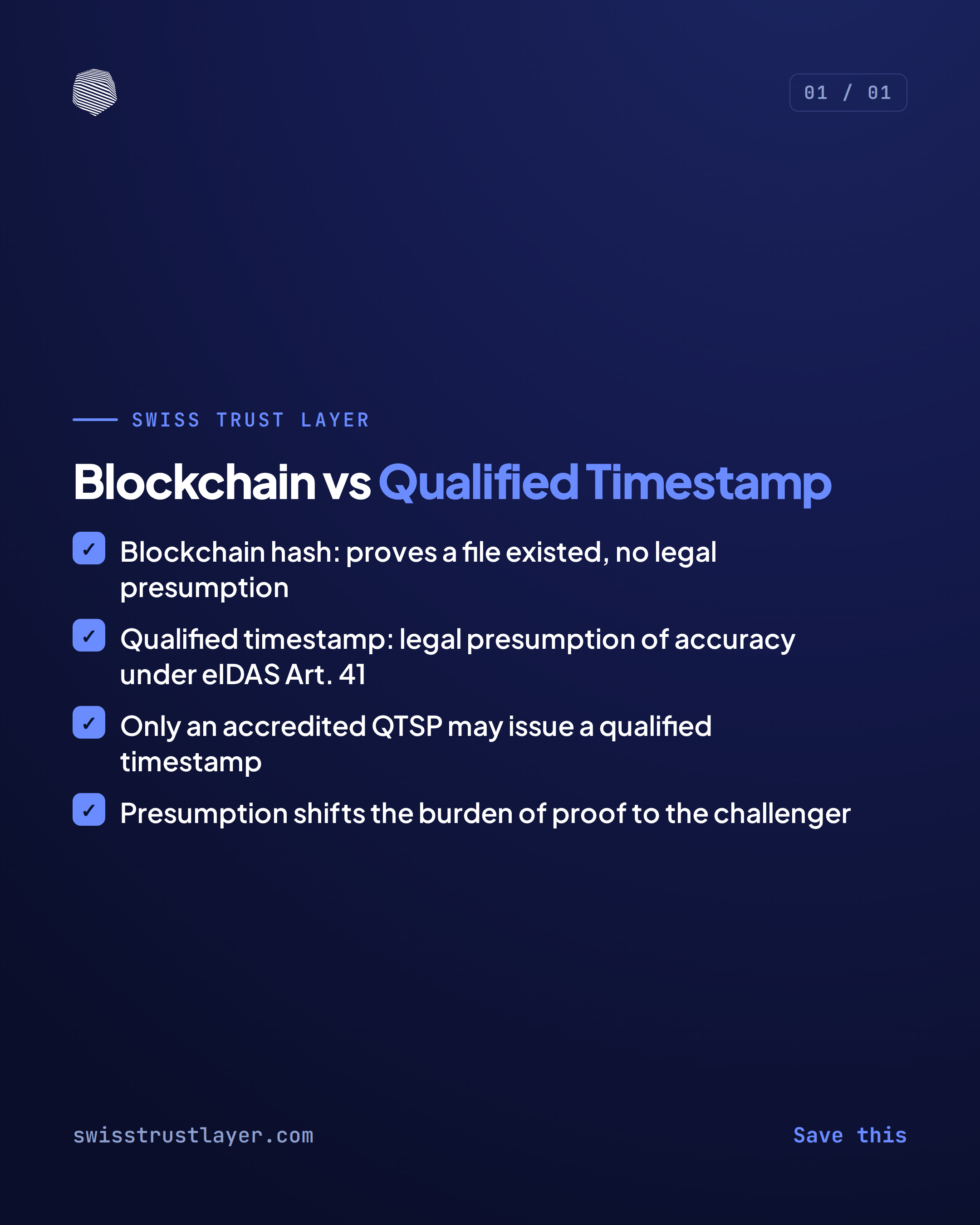
Blockchain timestamps have become a popular tool for documenting intellectual property. Store your file's hash on-chain, the argument goes, and you have immutable proof it existed at that moment. The logic is appealing. The legal reality is more limited.
What a blockchain timestamp actually proves
When you hash a file and record that hash on a blockchain, you create a tamper-evident record that the hash existed at the time of the transaction. The blockchain itself is a distributed ledger: no single party controls it, and altering a past transaction requires rewriting subsequent blocks, which is computationally prohibitive on established chains.
This is genuinely useful for some purposes. But the question is not whether the record is technically tamper-evident. The question is whether a court is required to treat it as reliable evidence.
The legal presumption gap
Under eIDAS Art. 41, a qualified electronic timestamp issued by a qualified trust service provider on the EU Trust List (EUTL) benefits from a legal presumption of accuracy. Courts across all 27 EU member states are required to treat it as reliable. The timestamp's accuracy of the date and time, and the integrity of the data bound to it, are presumed correct until proven otherwise.
No equivalent presumption exists for blockchain records under eIDAS, ZertES, or any major jurisdiction's statutory law. A blockchain record is admissible as evidence in principle, but it carries no legal presumption. The party relying on it must prove its reliability independently, typically through expert testimony explaining how the chain works, how the specific blockchain records were made, and why the record should be trusted. That is an expensive, uncertain process.
Under ZertES Art. 11, a qualified electronic signature carries the legal status of a handwritten signature. The accompanying qualified timestamp is what establishes when the document was signed. A blockchain-based timestamp does not satisfy this requirement under current Swiss law.
Why this matters for IP disputes
The practical difference surfaces in a dispute. Suppose a designer stores a work's hash on-chain at a known block height, then later needs to prove authorship in a Swiss or EU proceeding. The designer must:
- Explain to the court what the blockchain is and how it works
- Demonstrate the specific transaction's integrity
- Show the court why that transaction should be treated as reliable evidence of the file's existence at that date
- Separately prove the file's contents match the hash
With a qualified electronic timestamp from an accredited provider, step one is already handled by statute. eIDAS Art. 41 creates the presumption. The challenger must disprove it, not the other way around.
The corroboration problem
Courts do not reject blockchain evidence automatically. They assess its reliability in context. But "admissible if corroborated" is a weaker position than "presumed accurate unless disproved." In a contested dispute, weak positions cost money, time, and uncertainty. The party with the qualified timestamp spends that energy on the substance of the dispute. The party relying on a blockchain record spends it establishing that the record should be trusted at all.
For a full explanation of how qualified timestamps work and which documents should carry them, see the eIDAS qualified timestamp guide and the comparison of advanced versus qualified signatures.
What this means in practice
Blockchain timestamps are a reasonable supplementary record. They are not a substitute for qualified electronic timestamps under ZertES or eIDAS. If you need your IP documentation to carry legal presumption in Swiss or EU proceedings, the instrument is a qualified electronic timestamp from a provider on the BAKOM register or the EU Trust List, not a blockchain transaction.
The distinction is not about technology. It is about what the law says courts must presume.