
DocuSign processes more than a billion transactions annually. It is the market default for electronic signature workflows in most industries. For many document types, it is entirely appropriate. For some specific document types in Switzerland and the EU, it is not enough.
This is not a criticism of DocuSign. It is a structural fact about how electronic signature law works. Understanding the difference matters before signing documents where the legal stakes are high.
The three signature tiers under Swiss and EU law
Both ZertES (Switzerland) and eIDAS (EU) define three signature tiers:
- Simple Electronic Signature (SES): Any electronic data attached to a document, including scanned signatures, typed names, or click-to-sign. No identity verification required. Minimal legal weight.
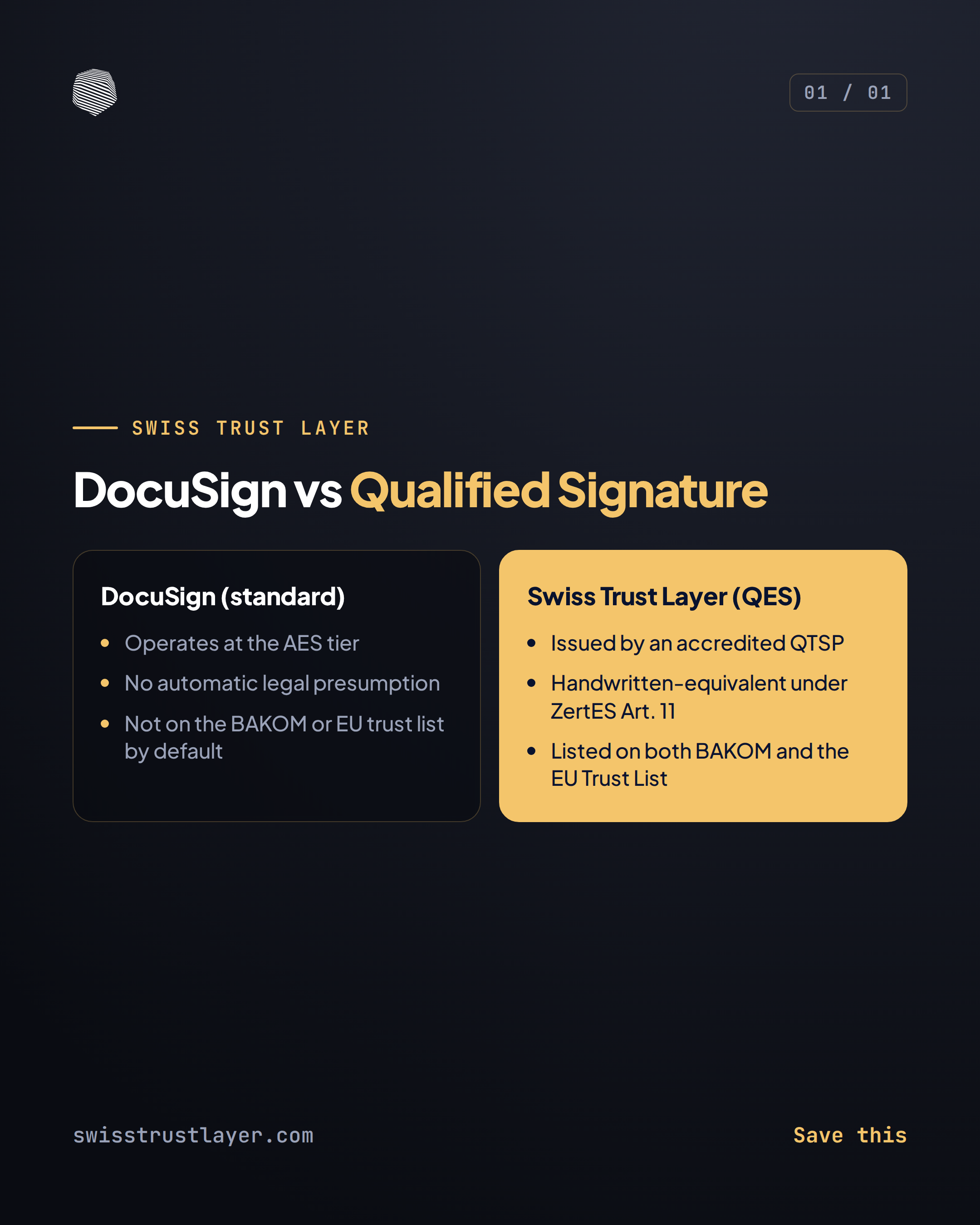
- Advanced Electronic Signature (AES): Linked to the signatory, capable of detecting changes, created with data under the signatory's sole control. DocuSign operates primarily at this tier. It does not carry automatic legal presumption in Swiss or EU courts.
- Qualified Electronic Signature (QES): Issued by an accredited Qualified Trust Service Provider (QTSP) on the EU/CH Trusted List. Requires in-person or video-based identity verification. Under ZertES Art. 11 and eIDAS Art. 25(2), legally equivalent to a handwritten signature with automatic presumption.
What DocuSign provides
DocuSign's standard product operates at the AES tier. DocuSign does offer a QES product in some markets through European TSP partners. However, this is not the default product most organisations use, and it requires explicit setup and verification steps that are separate from standard DocuSign workflows.
For many document types, AES is entirely sufficient. Standard commercial contracts, NDAs, service agreements, vendor agreements, internal approvals, and routine business correspondence are all appropriate for AES. The legal risk at AES is that if a signature is disputed, the party asserting its validity must prove authenticity.
Document types where QES is required in Switzerland
Swiss law specifies certain document types that require the equivalent of a handwritten signature. Under ZertES Art. 11, only QES meets that standard. Documents in this category include:
- Employment contracts containing non-compete clauses (OR Art. 340a requires written form)
- IP assignment and transfer agreements where the value is material
- Real estate-related contracts requiring written or notarised form under ZGB Art. 216
- Fiduciary mandate agreements and declarations of trust
- Cross-border data processing agreements with specific liability clauses under nDSG
Using AES on documents that legally require written form creates a signature that may not be enforceable in Swiss courts. The document can still be challenged, and the outcome of that challenge depends on whether the court treats AES as meeting the written form requirement, which is not guaranteed.
The identity verification gap
Standard DocuSign does not verify the identity of signatories against a government-issued document before issuing a signature. A QES requires this. The signatory must complete an identity verification step, either in-person or via video identification with an accredited TSP, before the signature is issued.
This matters because QES identity verification creates a direct, auditable link between the signature and a verified natural person. In a dispute, this link is part of what makes the legal presumption possible. Without it, the signature cannot carry presumption regardless of the cryptographic quality of the signing mechanism.
Where the two products are genuinely comparable
For most business documents, DocuSign AES and a qualified signature platform producing AES are comparable. The workflow experience is similar. The legal weight is the same at that tier.
The divergence is specifically at the QES tier, where document type, legal jurisdiction, or dispute risk require it. An organisation that signs all documents at AES and then faces a challenge on a document that required QES has a problem that no retrospective action can resolve.
The practical question
Before choosing a signing solution for a document type, the right question is: does this document type legally require written form equivalent in Switzerland or the relevant EU jurisdiction? If yes, only QES satisfies that requirement. If no, AES is likely sufficient for the specific document.
This assessment is best done before establishing workflows, not after a document is challenged. Review your high-value document types against the written form requirements in applicable Swiss law and determine which require QES coverage.
For a full comparison of SealMyIdea's qualified signing capabilities against standard AES platforms, see the DocuSign comparison page.