
Blockchain beweist, dass eine Datei existierte. Nicht, dass ein Gericht sie akzeptiert.
Legal

Blockchain beweist, dass eine Datei existierte. Nicht, dass ein Gericht sie akzeptiert.

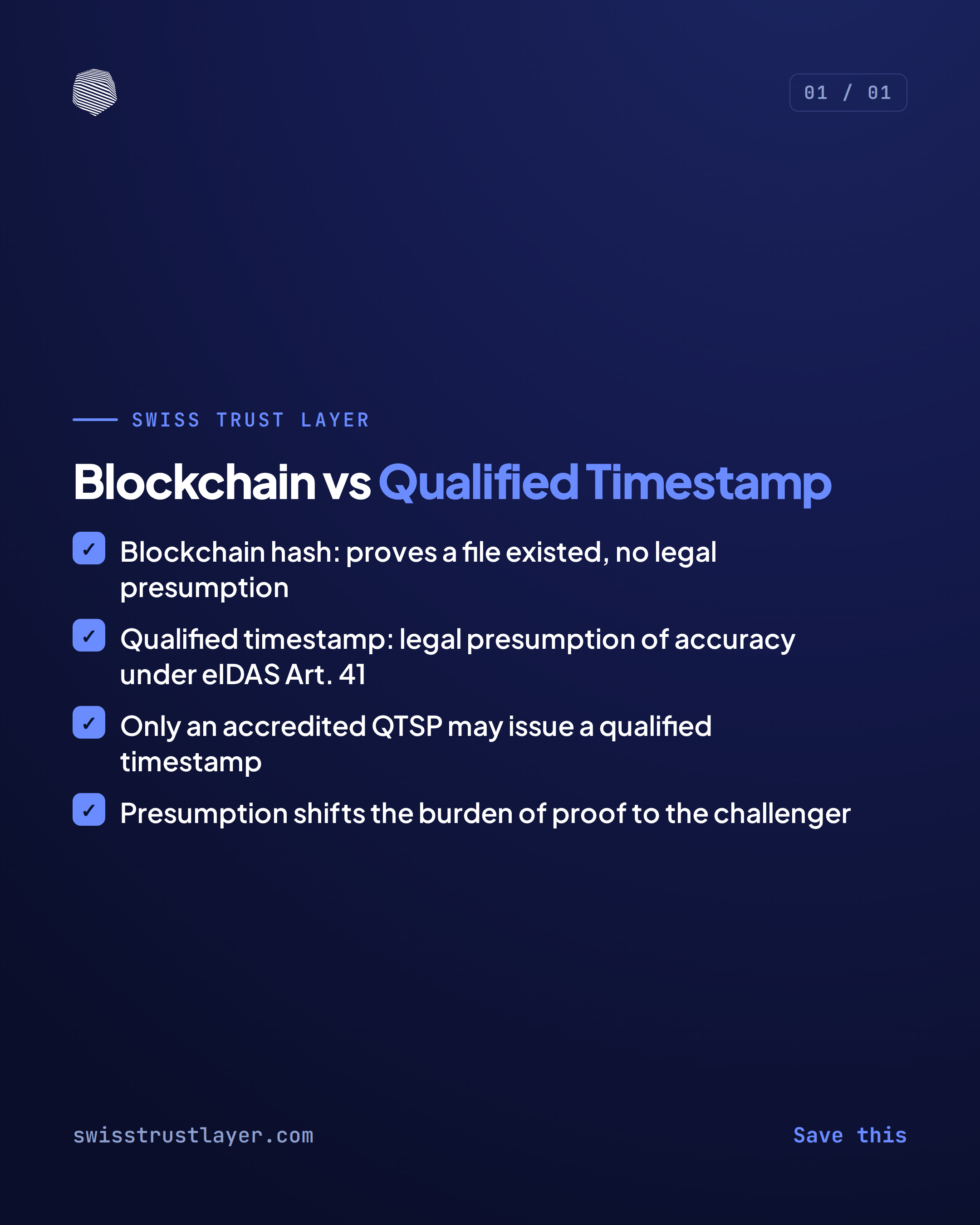
Ein Blockchain-Zeitstempel belegt, dass eine Datei zu einem Zeitpunkt existierte. Er trägt keine gesetzliche Vermutung nach eIDAS oder ZertES. Ein qualifizierter Zeitstempel eines akkreditierten QTSP schon.

S
Swiss Trust Layer· Legal Technology
·July 15, 2026· 6 Min. Lesen
Blockchain beweist, dass eine Datei existierte. Nicht, dass ein Gericht sie akzeptiert. — Swiss Trust Layer

Blockchain-Zeitstempel sind zu einem beliebten Werkzeug für IP-Dokumentation geworden. Die rechtliche Realität ist jedoch begrenzter als oft angenommen.

Die gesetzliche Vermutungslücke

Gemäss Art. 41 eIDAS geniesst ein qualifizierter elektronischer Zeitstempel eines akkreditierten QTSP eine gesetzliche Vermutung der Korrektheit. Gerichte in allen 27 EU-Mitgliedstaaten müssen ihn als zuverlässig behandeln. Kein gleichwertiger Schutz besteht für Blockchain-Zeitstempel. Gemäss Art. 11 ZertES trägt ein qualifizierter Zeitstempel zur Feststellung bei, wann ein Dokument unterzeichnet wurde. Ein Blockchain-Zeitstempel erfüllt diese Anforderung nach geltendem Schweizer Recht nicht.

Der Korroborierungsproblem

Gerichte lehnen Blockchain-Beweise nicht automatisch ab. Aber "zulässig wenn korroboriert" ist eine schwächere Position als "vermutet korrekt bis widerlegt". Im Streitfall kostet das Geld, Zeit und Unsicherheit. Die Partei mit dem qualifizierten Zeitstempel kann sich auf den Kern des Streits konzentrieren. Weitere Informationen: eIDAS-Leitfaden.


Schützen Sie Ihre Arbeit mit Swiss Trust Layer AG

Versiegeln Sie Ihr geistiges Eigentum mit einem gerichtsfesten e-Siegel, unterstützt von Swisscom Trust Services.

Demo buchen

Related Articles

The qualified signature workflow, start to finish
Legal

The qualified signature workflow, start to finish

A qualified electronic signature involves identity verification, signing ceremony, PAdES application, RFC 3161 timestamping, and public verification. Each step serves a specific legal purpose. This is what the process looks like from upload to verified certificate.

July 19, 2026Read more →
5 documents Swiss businesses should never sign with a basic e-signature
Legal

5 documents Swiss businesses should never sign with a basic e-signature

Swiss law specifies document types where only a qualified electronic signature carries the legal weight of a handwritten signature. Using a simple or advanced e-signature on these documents creates an enforceable gap that surfaces in disputes. Here are the five categories that matter.

July 18, 2026Read more →
DocuSign vs SealMyIdea: where a visual signature isn't enough
Legal

DocuSign vs SealMyIdea: where a visual signature isn't enough

DocuSign provides advanced and simple electronic signatures. For real estate, IP transfers, fiduciary mandates, and employment contracts in Switzerland, only a qualified electronic signature under ZertES Art. 11 carries legal presumption. This is the gap DocuSign cannot close.

July 17, 2026Read more →
For agencies: prove you authored the work and get clean client sign-off
Legal

For agencies: prove you authored the work and get clean client sign-off

Creative and digital agencies lose IP disputes because they cannot prove creation date or obtain legally binding client acceptance. A qualified electronic signature for client sign-off, combined with timestamped delivery, creates the complete audit trail that courts recognise.

July 16, 2026Read more →
What actually happens when a signed contract is challenged
Legal

What actually happens when a signed contract is challenged

When a signed contract is disputed, the outcome depends on the signature tier used. Learn how ZertES Art. 11 and eIDAS Art. 25(2) shift the burden of proof when it matters most.

July 14, 2026Read more →