
La blockchain prouve qu'un fichier a existé. Elle ne prouve pas qu'un tribunal l'acceptera.
Legal

La blockchain prouve qu'un fichier a existé. Elle ne prouve pas qu'un tribunal l'acceptera.

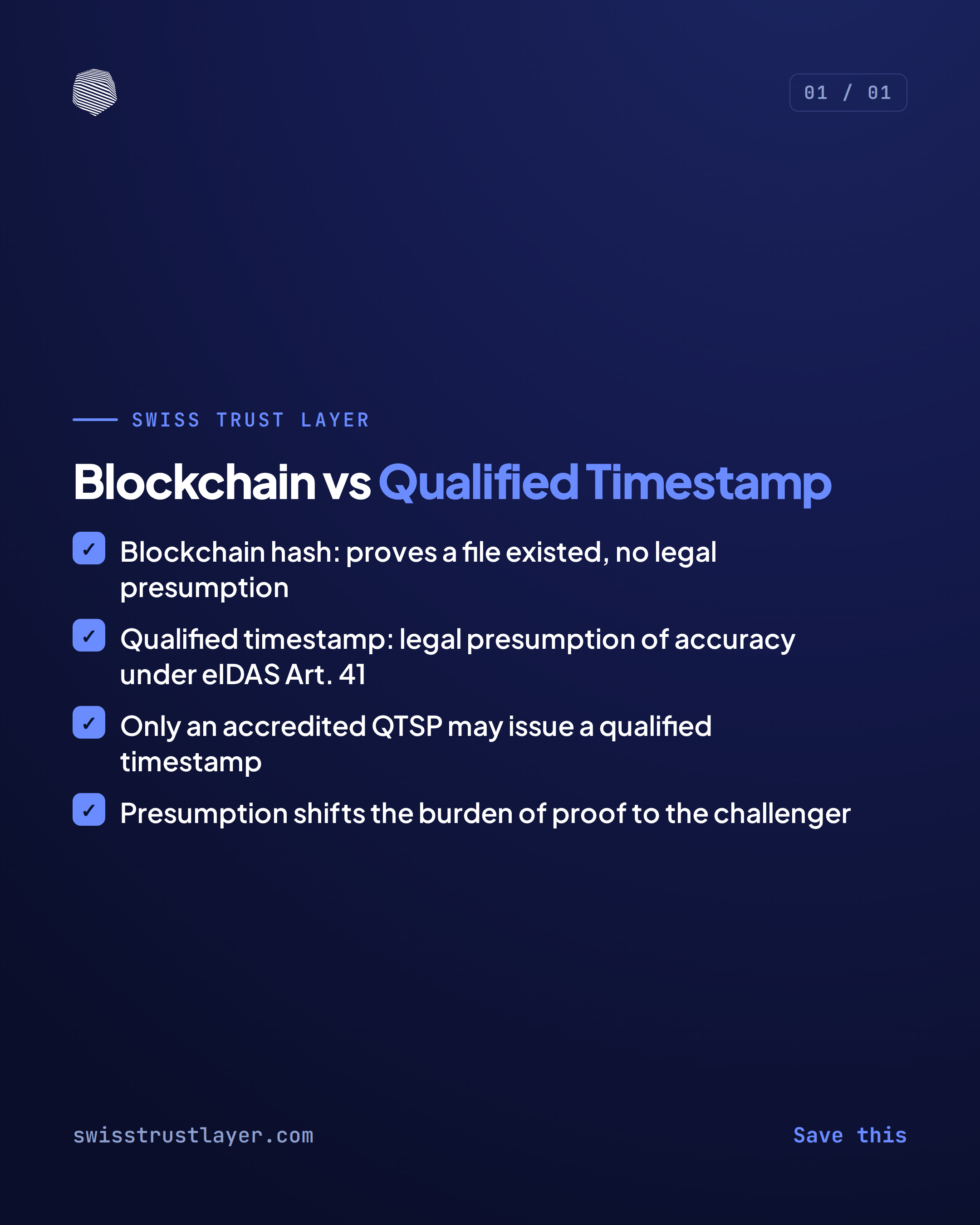
Un horodatage blockchain enregistre qu'un fichier a existé à un moment donné. Il ne bénéficie d'aucune présomption légale sous eIDAS ou ZertES. Un horodatage qualifié d'un QTSP accrédité, si.

S
Swiss Trust Layer· Legal Technology
·July 15, 2026· 6 min de lecture
La blockchain prouve qu'un fichier a existé. Elle ne prouve pas qu'un tribunal l'acceptera. — Swiss Trust Layer

Les horodatages blockchain sont populaires pour la documentation IP. La réalité juridique est cependant plus limitée.

Le déficit de présomption légale

En vertu de l'art. 41 eIDAS, un horodatage électronique qualifié d'un QTSP accrédité bénéficie d'une présomption légale d'exactitude. Les tribunaux des 27 États membres de l'UE sont tenus de le traiter comme fiable. Aucune présomption équivalente n'existe pour les enregistrements blockchain. Selon l'art. 11 ZertES, un horodatage qualifié établit quand un document a été signé. Un horodatage blockchain ne satisfait pas cette exigence en droit suisse actuel.

En pratique

Les horodatages blockchain sont un complément raisonnable mais ne remplacent pas les horodatages qualifiés sous ZertES ou eIDAS. Pour une IP protégée légalement, l'instrument est un horodatage qualifié d'un prestataire sur le registre BAKOM ou la liste de confiance UE. Voir le guide eIDAS.


Protégez votre travail avec Swiss Trust Layer AG

Scellez votre propriété intellectuelle avec un e-Sceau prouvé en justice, soutenu par Swisscom Trust Services.

Réserver une Démo Gratuite

Related Articles

The qualified signature workflow, start to finish
Legal

The qualified signature workflow, start to finish

A qualified electronic signature involves identity verification, signing ceremony, PAdES application, RFC 3161 timestamping, and public verification. Each step serves a specific legal purpose. This is what the process looks like from upload to verified certificate.

July 19, 2026Read more →
5 documents Swiss businesses should never sign with a basic e-signature
Legal

5 documents Swiss businesses should never sign with a basic e-signature

Swiss law specifies document types where only a qualified electronic signature carries the legal weight of a handwritten signature. Using a simple or advanced e-signature on these documents creates an enforceable gap that surfaces in disputes. Here are the five categories that matter.

July 18, 2026Read more →
DocuSign vs SealMyIdea: where a visual signature isn't enough
Legal

DocuSign vs SealMyIdea: where a visual signature isn't enough

DocuSign provides advanced and simple electronic signatures. For real estate, IP transfers, fiduciary mandates, and employment contracts in Switzerland, only a qualified electronic signature under ZertES Art. 11 carries legal presumption. This is the gap DocuSign cannot close.

July 17, 2026Read more →
For agencies: prove you authored the work and get clean client sign-off
Legal

For agencies: prove you authored the work and get clean client sign-off

Creative and digital agencies lose IP disputes because they cannot prove creation date or obtain legally binding client acceptance. A qualified electronic signature for client sign-off, combined with timestamped delivery, creates the complete audit trail that courts recognise.

July 16, 2026Read more →
What actually happens when a signed contract is challenged
Legal

What actually happens when a signed contract is challenged

When a signed contract is disputed, the outcome depends on the signature tier used. Learn how ZertES Art. 11 and eIDAS Art. 25(2) shift the burden of proof when it matters most.

July 14, 2026Read more →