
DocuSign vs. SealMyIdea: Wo ein optisches Signaturbild nicht ausreicht
Legal

DocuSign vs. SealMyIdea: Wo ein optisches Signaturbild nicht ausreicht

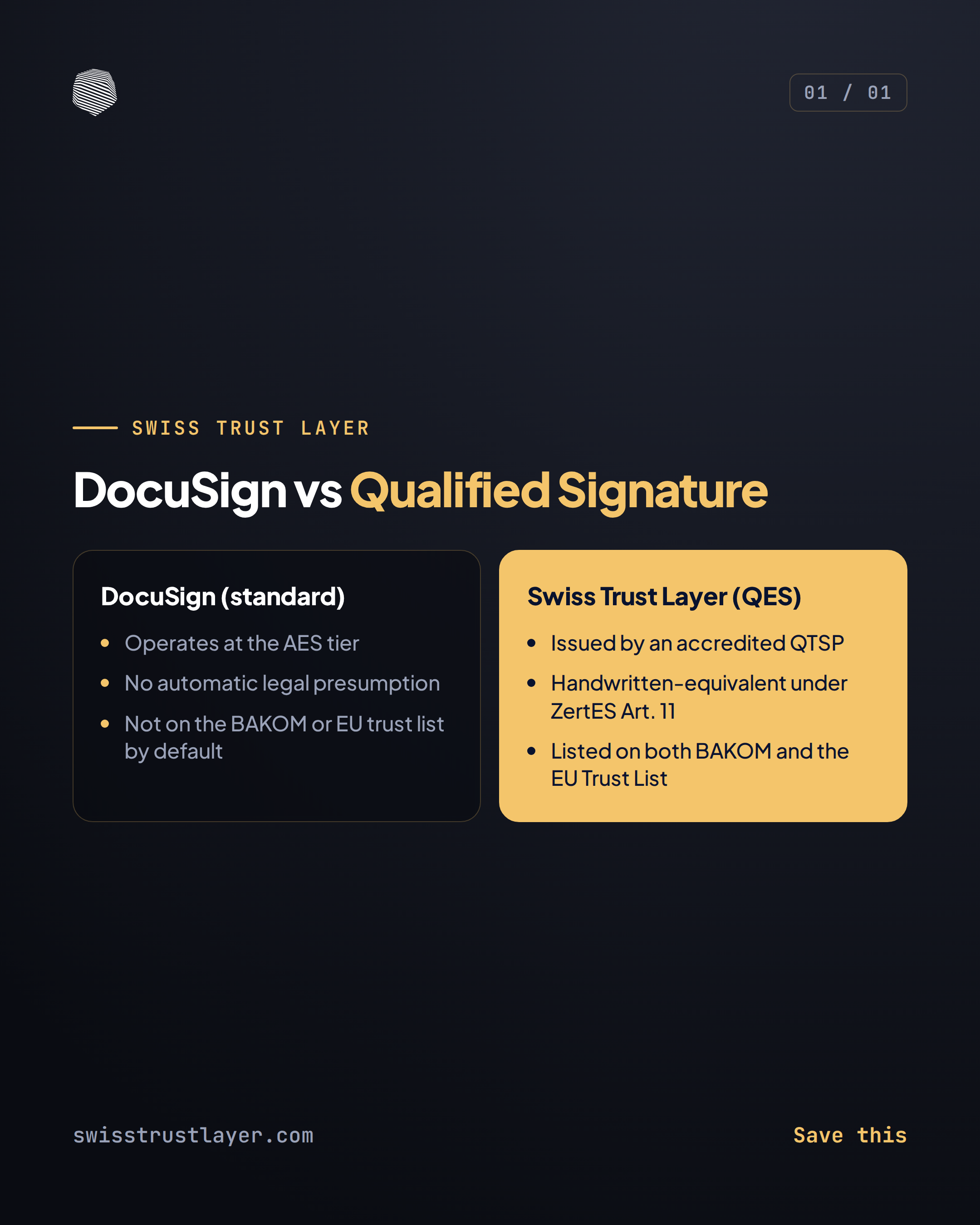
DocuSign bietet fortgeschrittene und einfache elektronische Signaturen. Fuer Immobilien, IP-Uebertragungen, Treuhandmandate und Arbeitsvertraege in der Schweiz traegt nur eine qualifizierte elektronische Signatur gemaess ZertES Art. 11 gesetzliche Vermutung. Diese Luecke kann DocuSign nicht schliessen.

S
Swiss Trust Layer Editorial Team· Legal Technology Analysis
·July 17, 2026· 7 Min. Lesen
DocuSign vs. SealMyIdea: Wo ein optisches Signaturbild nicht ausreicht — Swiss Trust Layer

DocuSign verarbeitet jaehrlich mehr als eine Milliarde Transaktionen. Fuer viele Dokumententypen ist es voellig angemessen. Fuer bestimmte Dokumententypen in der Schweiz und der EU reicht es nicht aus.

Die drei Signaturstufen nach Schweizer und EU-Recht

Sowohl ZertES als auch eIDAS definieren drei Signaturstufen: einfache elektronische Signatur (EES), fortgeschrittene elektronische Signatur (FES) und qualifizierte elektronische Signatur (QES). DocuSign arbeitet hauptsaechlich auf FES-Ebene, ohne automatische gesetzliche Vermutung.

Dokumententypen, fuer die QES in der Schweiz erforderlich ist

Gemaess ZertES Art. 11 erfuellt nur die QES die Anforderungen an die handschriftliche Unterschrift. Dazu gehoeren: Arbeitsvertraege mit Wettbewerbsverboten (OR Art. 340a), IP-Uebertragungsvereinbarungen, Immobilienvertraege (ZGB Art. 216) und Treuhandvereinbarungen.

Die Identitaetsverifizierungsluecke

Standard-DocuSign verifiziert die Identitaet der Unterzeichner nicht vor Ausstellung einer Signatur. Eine QES erfordert dies. Der Unterzeichner muss einen Identitaetsverifizierungsschritt abschliessen, bevor die Signatur ausgestellt wird. Ohne diese Verifikation kann die Signatur keine Vermutung tragen.


Schützen Sie Ihre Arbeit mit Swiss Trust Layer AG

Versiegeln Sie Ihr geistiges Eigentum mit einem gerichtsfesten e-Siegel, unterstützt von Swisscom Trust Services.

Demo buchen

Related Articles

The qualified signature workflow, start to finish
Legal

The qualified signature workflow, start to finish

A qualified electronic signature involves identity verification, signing ceremony, PAdES application, RFC 3161 timestamping, and public verification. Each step serves a specific legal purpose. This is what the process looks like from upload to verified certificate.

July 19, 2026Read more →
5 documents Swiss businesses should never sign with a basic e-signature
Legal

5 documents Swiss businesses should never sign with a basic e-signature

Swiss law specifies document types where only a qualified electronic signature carries the legal weight of a handwritten signature. Using a simple or advanced e-signature on these documents creates an enforceable gap that surfaces in disputes. Here are the five categories that matter.

July 18, 2026Read more →
For agencies: prove you authored the work and get clean client sign-off
Legal

For agencies: prove you authored the work and get clean client sign-off

Creative and digital agencies lose IP disputes because they cannot prove creation date or obtain legally binding client acceptance. A qualified electronic signature for client sign-off, combined with timestamped delivery, creates the complete audit trail that courts recognise.

July 16, 2026Read more →
Blockchain proves a file existed. It doesn't prove a court will accept it.
Legal

Blockchain proves a file existed. It doesn't prove a court will accept it.

A blockchain timestamp records that a file existed at a point in time. It carries no legal presumption under eIDAS or ZertES. A qualified electronic timestamp issued by an accredited QTSP does.

July 15, 2026Read more →
What actually happens when a signed contract is challenged
Legal

What actually happens when a signed contract is challenged

When a signed contract is disputed, the outcome depends on the signature tier used. Learn how ZertES Art. 11 and eIDAS Art. 25(2) shift the burden of proof when it matters most.

July 14, 2026Read more →