Two different legal exposures land on any team training an AI model, and they come from two different directions. The first is regulatory: from 2 August 2026, Article 10 of the EU AI Act requires providers of high-risk AI systems to document their training, validation, and testing datasets, including data collection processes and the origin of the data. The second is civil: a copyright holder can claim their work was used without permission, and the burden lands on the AI company to show what data it actually used and how it was obtained.
Both exposures ask a version of the same question: what is in the dataset, where did it come from, and when did you get it. That question is what "provenance" means in practice, and it is worth being precise about what a timestamped record can and cannot prove.
What Article 10 actually requires
Article 10 applies to high-risk AI systems and sets out data governance practices a provider must have in place. The obligations cover design choices made in collecting the data, the data collection process itself and the origin of the data, preparation steps such as annotation, labelling, and cleaning, an assessment of whether the dataset is relevant and sufficiently representative for its intended purpose, and an examination for possible bias. Where a provider identifies gaps that prevent compliance, that has to be documented too.
None of this asks a company to prove it has cleared every copyright in a training set. Article 10 is a data-quality and governance regime, not a copyright-clearance regime. But answering it well requires the same underlying record a copyright defense needs: what data went in, where it came from, and when.
The separate civil exposure
Copyright claims against AI training practices are a live and active area of litigation in multiple jurisdictions, with cases brought by publishers, authors, music rights holders, and image libraries against major AI developers. The legal theories differ by jurisdiction and by case, and courts are still working through core questions such as whether training on copyrighted material is transformative use and how licensing obligations interact with data mining exceptions. We are not going to predict how any specific case resolves, and a training-data record does not resolve that question either.
What a claim like this actually turns on, in practice, is evidence. If a rights holder alleges their work was scraped without permission, the AI company's answer depends on being able to show, with a record it did not write after the fact, what it collected, from where, and under what terms. A company that cannot reconstruct its own data supply chain is arguing from memory against a plaintiff with a specific complaint.
What "provenance" means for a dataset, practically
Chain of custody for a training dataset breaks down into three things worth tracking separately:
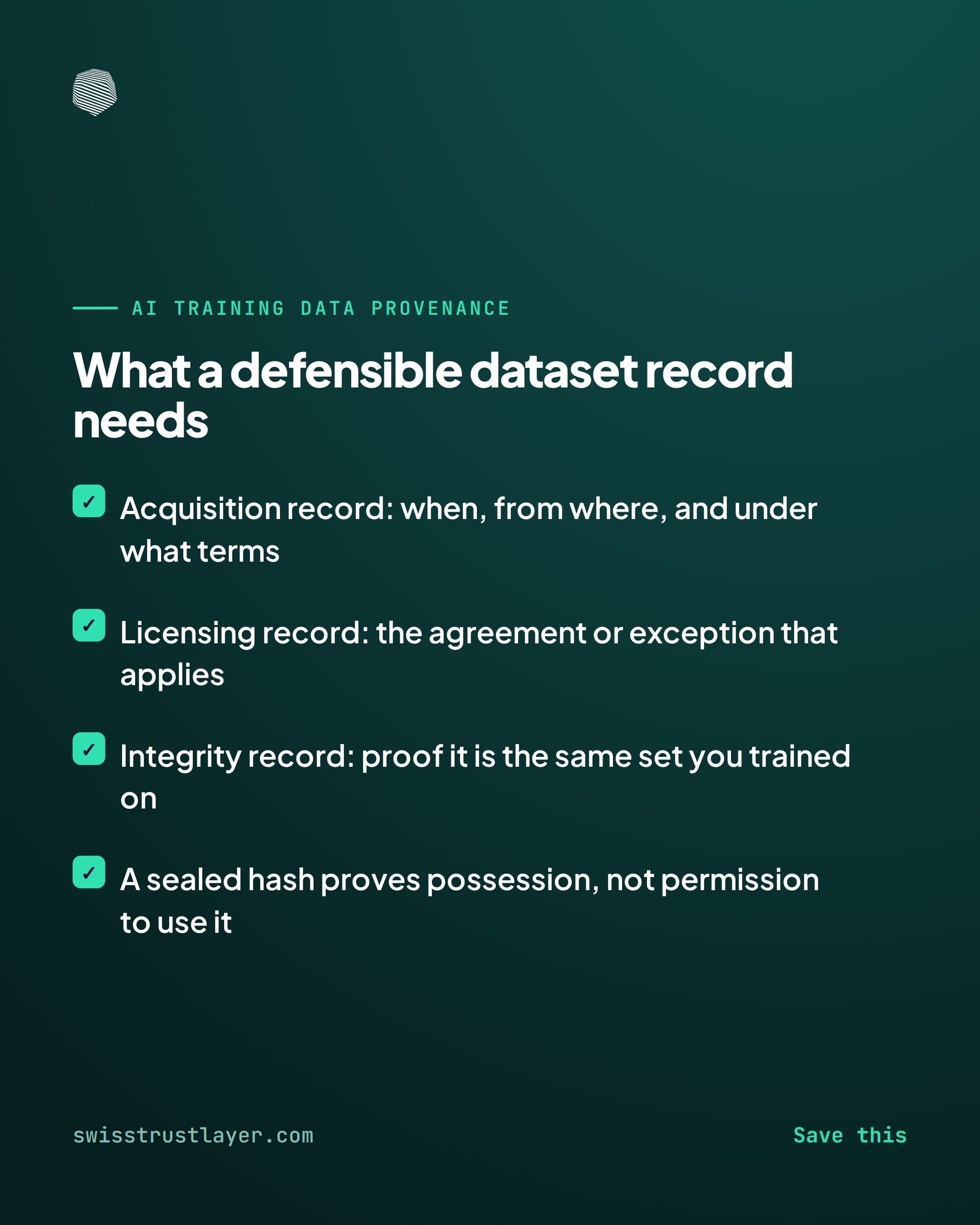
- Acquisition record. When was a source added to the corpus, from which URL, API, licensor, or vendor, and under what version of that source's terms at the time.
- Licensing record. What agreement, if any, covers the use, whether it is a direct license, a platform terms-of-service grant, an open license, or reliance on a text-and-data-mining exception such as Article 4 of the Digital Single Market Copyright Directive, and whether the rights holder had reserved rights against that exception in a machine-readable way.
- Integrity record. Proof that the dataset a company points to today is the same one it actually trained on, not a reconstruction assembled afterward for the purposes of a dispute.
Of those three, the integrity record is the one most teams have no good answer for. Acquisition and licensing records tend to live in scattered emails, vendor contracts, and internal wikis. Even where they exist, there is often no way to prove the dataset referenced in those documents is the same set of files the model was actually trained against, months or years later.
What a qualified timestamp proves, and what it does not
Sealing a cryptographic hash of a dataset at the point of acquisition, with a qualified timestamp, creates a defensible record that a specific set of bytes existed and was in your possession at a specific point in time. That is a narrow but genuinely useful claim. It means you can show a court, months or years later, exactly what the dataset looked like when you collected it, without relying on your own say-so or a document that could have been edited afterward.
Be precise about the limits of that claim, because overstating it is worse than not making it. A sealed hash proves existence and possession at a point in time. It does not prove you had permission to use the content, and it does not prove the content was lawfully obtained in the first place. Licensing and permission are separate legal questions that a timestamp cannot answer on its own. What it does is remove one entire category of dispute, whether you can even show what you had and when, so that the actual argument about licensing terms can happen on the facts instead of on whose account of events a court is willing to believe.
For a company facing a regulator asking about Article 10 data governance, or a rights holder alleging unauthorized use, the difference between "here is a timestamped hash of the exact dataset, sealed on the date we acquired it, alongside our licensing records" and "we believe this is roughly what we used" is the difference between a defensible position and an unverifiable one.
Where this fits into a practical workflow
Teams building AI products who need to defend both the Article 10 governance question and the underlying copyright question benefit from treating dataset acquisition as a discrete, sealed event rather than an ongoing, mutable folder. Hash and seal a dataset snapshot at acquisition, attach the licensing terms that applied at that moment, and keep that record separate from whatever downstream cleaning or filtering happens next. If a dispute arrives later, about a specific source, a specific date, or a specific license, the record already exists rather than needing to be reconstructed under pressure.
Our AI dataset provenance page covers how this works for teams that need a timestamped, court-admissible record of what a dataset contained and when it was acquired, alongside the licensing documentation that answers the separate question of permission.