Camera makers, editing tools, and several AI generators now embed C2PA Content Credentials in the files they produce. The Coalition for Content Provenance and Authenticity, founded in 2021 by Adobe, Arm, BBC, Intel, Microsoft, and Truepic and now backed by the Joint Development Foundation under the Linux Foundation, built the standard to answer a real problem: once a piece of media leaves its source, there is often no reliable way to tell where it came from or what happened to it along the way.
C2PA is a genuine step forward on that problem. It is also not, on its own, a system an AI company or content team can rely on for legal or evidentiary weight, because of how and where the credentials get lost. Here is what the standard actually does, where it breaks down in practice, and where a separate, qualified timestamp fits alongside it.
What a Content Credential actually records
A C2PA manifest, called a Content Credential, is a signed data structure attached to a file. It can record who or what created the content, which tools were used, whether AI was involved, and every edit made since capture. Each manifest is signed with a private key, and a certificate chain lets anyone verify the signature without contacting the original creator. If a file is altered after the manifest was signed, the signature breaks and the tampering is detectable. That is a well-designed piece of cryptography, and it works as intended for as long as the manifest stays attached to the file.
Where the metadata gets stripped
The gap is not in the cryptography. It is in what happens to a file after it leaves the tool that signed it. Uploading, downloading, screenshotting, resizing, and recompressing an image or video routinely breaks or removes the embedded manifest. Instagram, X, LinkedIn, TikTok, WhatsApp, and iMessage all reprocess uploaded media through compression pipelines built to shrink file size, not to preserve signed metadata, and several of these platforms strip Content Credentials before the content ever reaches another viewer. This is not a deliberate policy against provenance. It is a side effect of infrastructure designed years before C2PA existed. The practical result is the same either way: content that carried a valid credential when it was created can arrive at its destination with none.
Provenance is not authenticity
C2PA and the Content Authenticity Initiative are explicit about what the standard does and does not establish. A valid, unbroken signature confirms that a manifest has not been modified since signing and can be tied to a specific key. It does not confirm that the underlying content is real, true, or accurately represents what it claims to show. A deepfake produced by a fully C2PA-conformant camera app or editing tool can carry a perfectly valid credential, because the standard certifies the history of the file, not the truth of what is depicted in it. There is also a first-mile limit: C2PA can confirm that a specific device or piece of software made a specific claim at a specific point, but it has no way to verify what happened before that first signing step, and it cannot prove a negative either. A file with no credentials at all might be manipulated, or it might simply be old, unsigned, or produced by a tool that has not adopted the standard.
Where a qualified timestamp adds something a manifest cannot
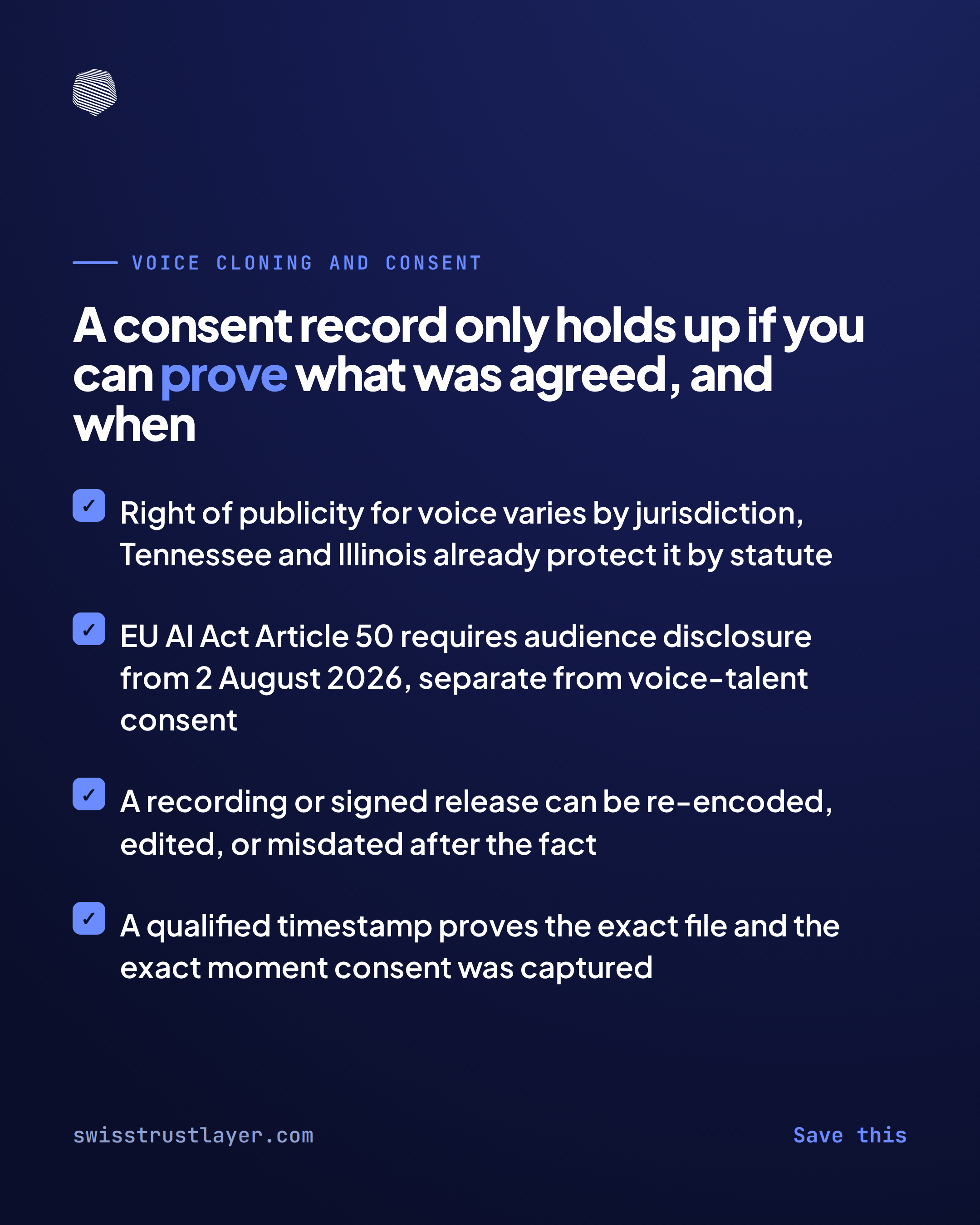
None of this makes C2PA a bad standard. It is a well-built, increasingly adopted signal that is genuinely useful whenever it survives intact. The problem for AI companies and content teams is that "whenever it survives intact" excludes most of the places their content actually travels. A qualified, cryptographically sealed timestamp works differently: it is issued independently of the file's own embedded metadata, so recompressing an image or reposting a document to a platform that strips manifests does not touch it. It establishes that a specific file existed in a specific state at a specific time, verifiable through the sealing record rather than through anything carried inside the file. That is a narrower claim than what C2PA is trying to do, and it does not replace the machine-readable, detectable marking that regulations such as EU AI Act Article 50 ask AI-generated content to carry. It is complementary evidence: useful for training records, dataset documentation, model output logs, and disputes where a party needs to show what a file was and when it existed, independent of whether the platform in between preserved anything at all.
What this means in practice
Use C2PA where your tools support it. It is a real, freely available signal and there is no reason to skip it. But plan around the fact that it will not travel with your content everywhere that content goes, and do not treat an intact Content Credential as proof of authenticity rather than proof of a signed history. For records that matter later, training data provenance, generated-output samples, disclosure logs, keep an independent, timestamped copy outside the platform pipeline that might strip the metadata. Our AI dataset provenance page covers how that documentation obligation intersects with EU AI Act data-governance requirements in more detail.