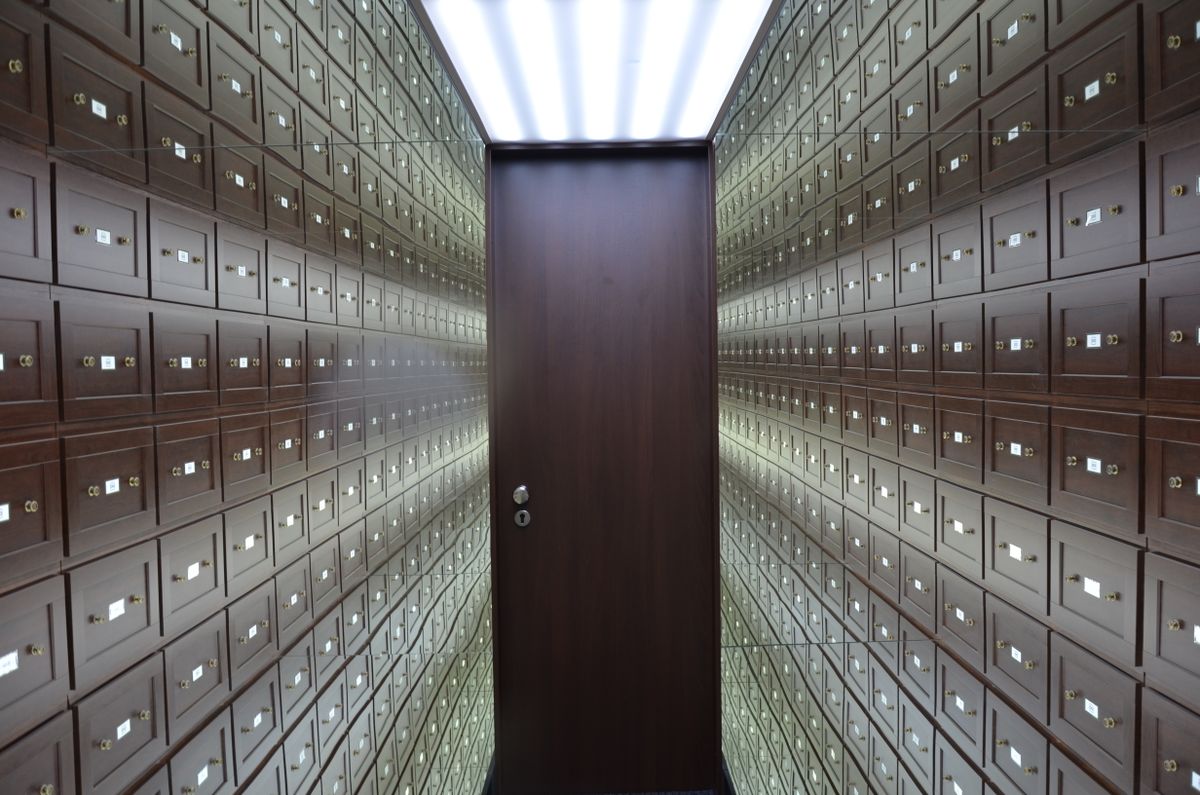

Think about how you would get back into your accounts if today went badly. The laptop is gone, the phone with it, the password manager was on both, and the recovery email is one of the accounts you are locked out of. Most people have never had that day. The ones who have will tell you it is not the login you miss. It is everything the login was standing in front of.
The reset email only works until it doesn't
Almost every service handles a forgotten password the same way. You type your email, it sends a six-digit code, you set a new password, you are back in. It works because the email account is the thing it trusts. The email is the key to the key.
So the whole system rests on one assumption: that you still control that email. Lose it too, and the reset flow has nothing to fall back on. The support desk cannot simply believe you are you, because a stranger would say the same thing. For an ordinary cloud drive that is an annoyance. For a record that is supposed to prove you made something, it is the whole value gone in an afternoon.
A record is only as good as your ability to reach it
This is the quiet weakness in most proof-of-ownership tools. They will happily seal your work and hand you a certificate. Ask them what happens if you lose every way of logging in, and the honest answer is that the proof is still there, sitting behind a door you can no longer open. Proof you cannot reach on the day you need it is not proof. It is a story about proof.
The fix is not a longer password or one more backup code. It is to stop tying recovery to something you hold at all, and tie it to something you are.
Tied to a verified person, not a credential
On Swiss Trust Layer, every registration is bound to a verified identity from the start. You are not an anonymous email address with a password. You are a known, identity-checked person, and the record knows it.
Every sealed folder is also deposited automatically into Swiss escrow storage, held in Switzerland, and each deposit carries its own escrow ID. That ID is not a password and it is not secret in the way a password is. It is a reference to your deposit, the thing a recovery is done against.
Put those two facts together and the recovery problem changes shape. The question is no longer "can you produce the credential," which a thief could also try to answer. It is "can you prove, in person, that you are the verified individual this deposit belongs to," which only you can.
How the recovery actually works
Keep your escrow ID somewhere you can find it, the way you would keep a safe-deposit number. It identifies your deposit for in-person recovery through ProLitteris. If you lose access to everything else, that is the path back: your identity is re-verified in person, the deposit is matched to you, and your sealed records are restored to you.
Notice what is not in that sentence. No reset email you might have lost. No security questions a stranger could research. No single device that, once gone, takes the account with it. The recovery leans on the one thing that does not get lost with your hardware, which is you.
One detail worth stating plainly: the move into escrow is one-way. Files deposited into Swiss escrow are not migrated back out to an ordinary cloud. That is deliberate. The point of escrow is that the recoverable copy stays in a controlled place, not that it is casually shuffled between drives.
Why this is the point, not a footnote
A registration is a promise that you will still be able to prove authorship years from now. Years is long enough to lose a laptop, change phones twice, and forget which email you used. If a single one of those events can permanently separate you from your proof, the promise was never real.
Binding recovery to a verified identity is what makes the promise hold. It is the same idea that lets the underlying registration stand up wherever it is tested rather than only where you happen to live: the proof is anchored to a checked human, so it travels, and it survives. Recovery is simply that same principle pointed at the worst day instead of the best one.
The plain version
A password reset protects you against forgetting. It does nothing for you against losing everything at once. Because your registration is tied to your verified identity and your deposit sits in Swiss escrow with its own ID, you can be locked out of every device and account and still get your records back, in person, as yourself. Keep the escrow ID, and the login stops being the thing your proof depends on.
See how the register works, and how recovery is built into it, on the Swiss Copyright Registry.