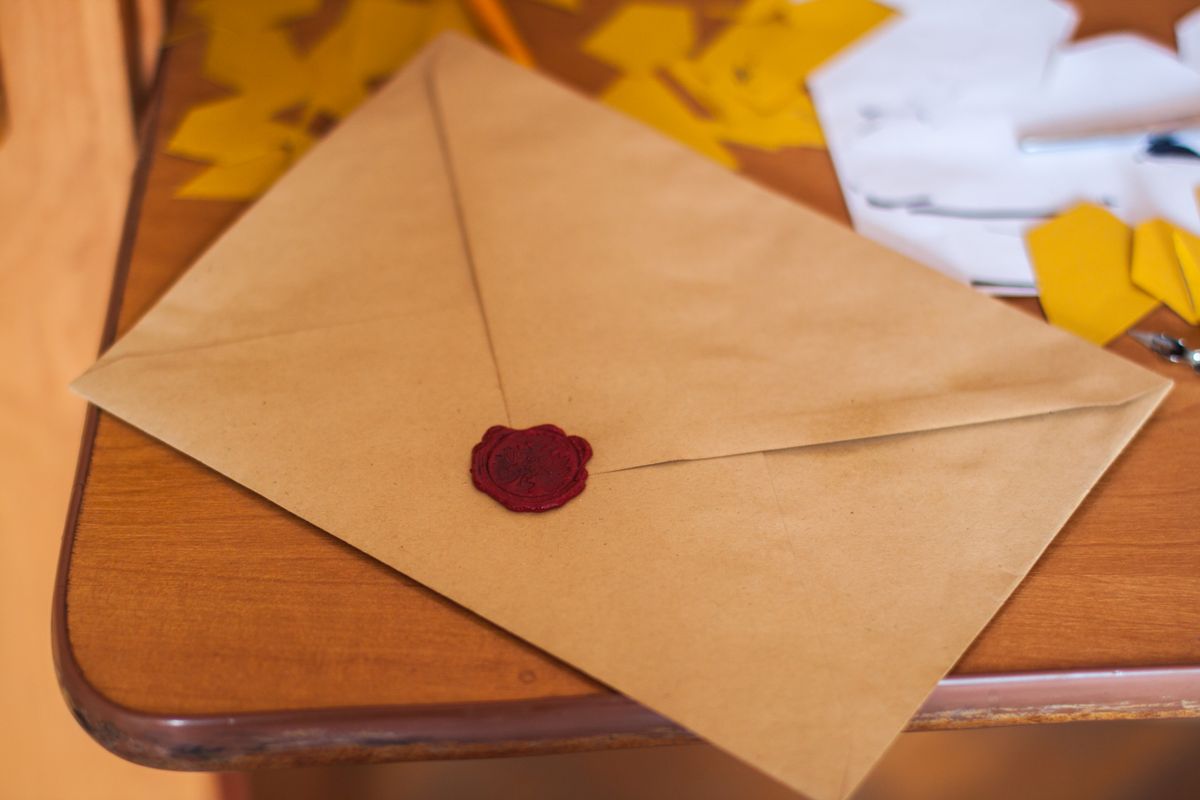
Somewhere in most creative communities, someone will tell you the same piece of advice: print your work, seal it in an envelope, mail it to yourself, and never open it. The postmark, the story goes, proves you had the work on that date. It costs the price of a stamp, and it has been passed down for decades. It is also not the reliable proof most people assume it is.
The idea has a name, "poor man's copyright," and the name itself gives away the problem. It is a workaround people reach for because a real, checkable record felt out of reach. That is no longer the case, but the envelope trick is still repeated as if it were.
What the sealed envelope actually proves
A postmark shows that a postal service processed an envelope on a given date. It says nothing, on its own, about what was inside that envelope at the time. The envelope can be steamed open and resealed. The postmark itself can be faint, disputed, or, on international mail, sometimes missing the level of detail a dispute would need. Nobody independent examined the contents at the time and recorded what they were. If a disagreement reaches a formal setting, an unopened envelope is one party's word about what an unopened envelope contains, at exactly the moment that word is being questioned.
This is not a comment on the honesty of the person mailing it. It is a structural problem: the method was never designed to produce a record that a third party can independently check. It produces a physical object that depends entirely on trusting the process nobody watched.
What actually changed
Under the Berne Convention, copyright already exists the moment you create a work, in every member country. The envelope trick was never about establishing ownership. It was always an attempt to answer a narrower question: if this is ever disputed, what proves I had it on this date?
A qualified electronic timestamp answers that question directly. The exact file, not a description of it, is hashed. That hash is bound to a timestamp issued by an accredited Qualified Trust Service Provider, in our case Swisscom Trust Services, accredited under both ZertES in Switzerland and eIDAS in the EU. Under eIDAS Article 41, a qualified timestamp carries a legal presumption of the accuracy of the date and time it shows, and of the integrity of the data it is bound to. That presumption did not exist for a mailed envelope, because nobody accredited was verifying anything at the moment it was created.
Why the difference matters in practice
The gap shows up exactly when it counts: a dispute, months or years later. A sealed digital record produces a certificate anyone can independently check, no unopened envelope required, no trust in an untouched physical object. It is bound to the precise bytes of the file, so a single changed character breaks the match. An envelope cannot make that claim about its own contents.
The advice to mail yourself a copy is not malicious, and it is not entirely useless as a habit. But treating it as equivalent to a verifiable record is where the myth causes real harm, usually discovered at the worst possible moment.