
Setting up a company in the UAE runs through a stack of paperwork before a license is issued: a Memorandum of Association, shareholder resolutions on capital and share classes, powers of attorney for anyone signing on behalf of a shareholder who cannot appear in person, a Good Standing Certificate for corporate shareholders, and, for mainland entities, a Local Service Agent agreement. Free zone authorities typically manage attestation for the documents they oversee, while mainland filings generally go through a notary process. Either way, the paperwork usually passes through several hands before the license is granted.
For a corporate-services or company-formation firm running several incorporations at once, that paperwork chain is the actual operational risk. Shareholders are often in different countries. A draft MOA gets revised twice before signing. A power of attorney is couriered, signed, and returned. By the time the file reaches a bank for account opening or an investor for due diligence, the question is rarely "is this the right template", it is "is this the exact version that was actually signed, and when".
Where the documents usually get questioned
A few points in a typical formation file tend to draw the most scrutiny later:
- The Memorandum of Association. It sets out the company's structure, objectives, and shareholder relationships, and it is the document a bank or authority will compare against whatever was actually filed.
- Shareholder resolutions. Capital structure, share classes, transfer restrictions, and voting rights are usually confirmed by resolution, and a later dispute between shareholders often turns on which version of that resolution was signed and when.
- Powers of attorney. Where a shareholder authorises someone else to sign on their behalf, the POA itself needs to be traceable back to a specific, unaltered document, not just a notarised stamp on a page that could theoretically have been swapped.
- Corporate shareholder documents. A parent company's own MOA, financial statements, and Good Standing Certificate travel as part of the file, and their currency (a Good Standing Certificate is typically only accepted within a few months of issue) matters as much as their content.
None of this is unique to the UAE. It is the normal friction of multi-party, multi-jurisdiction paperwork. What is specific to formation work is the volume: a firm running a dozen incorporations a month is handling a dozen versions of this same chain in parallel, often for clients who never meet each other or the formation firm in person.
What a sealed record actually adds
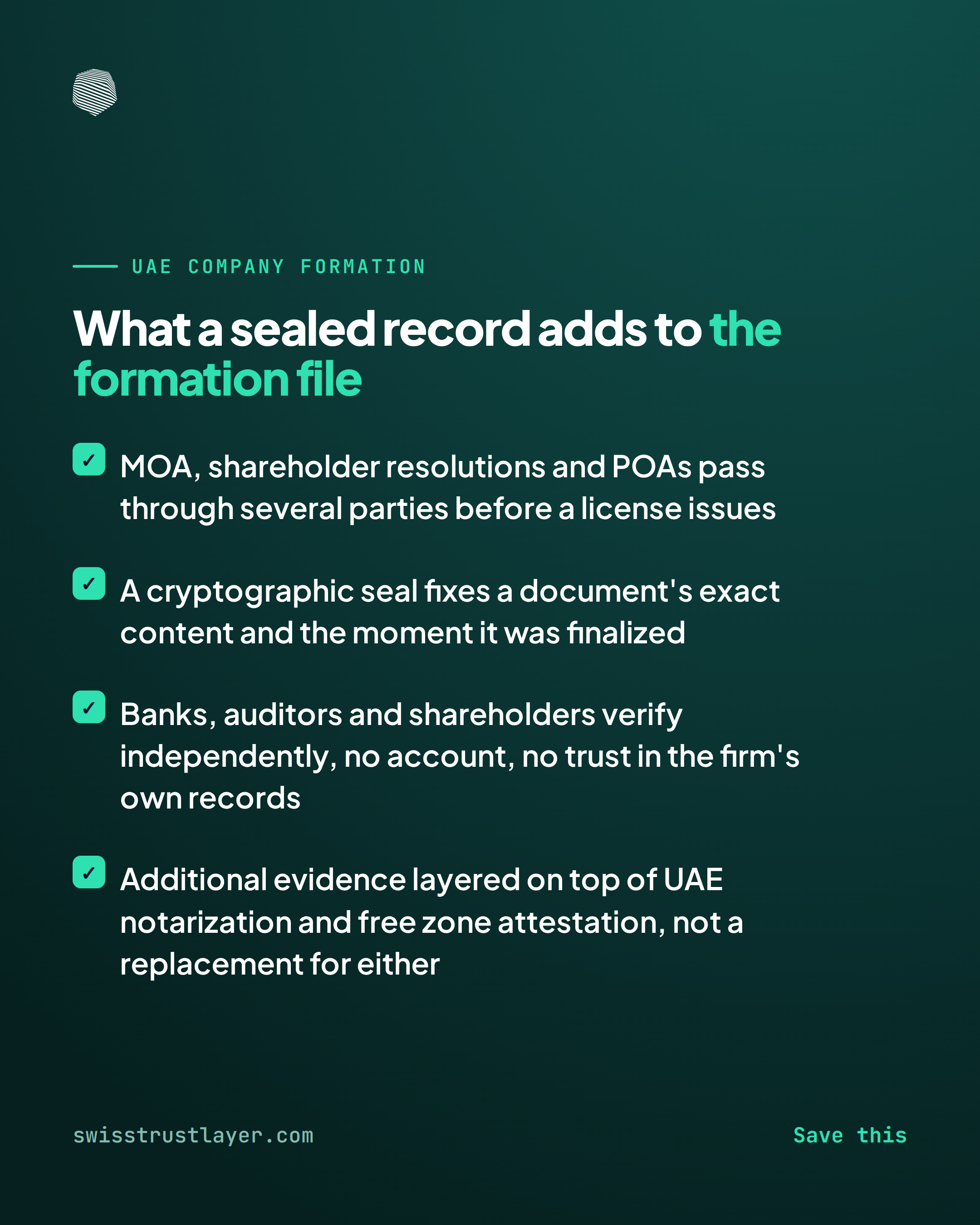
Swiss Trust Layer lets a formation firm apply a cryptographic seal to a document at the moment it is finalised, before it goes out for signature or into a filing package. The seal records the file's exact content and the precise time it was sealed, and produces a certificate that anyone, a bank, an auditor, a shareholder, an authority, can check independently at a public verification link, without needing an account or access to the firm's own systems.
That independence is the useful part. A shareholder in one country and a bank compliance officer in another do not have to take the formation firm's word that a document is the final, unaltered version. They can check it themselves. If a dispute later arises about which draft was actually signed, the seal's timestamp and content hash settle the question without relying on anyone's internal record-keeping or email trail, which is exactly the kind of evidence that tends to fall apart under scrutiny.
Multi-signature workflows matter here too. Where more than one shareholder needs to sign the same resolution or MOA, each signature can be captured against the same sealed document, so the final file shows who signed, in what order, and when, rather than a firm having to reconcile separately-signed copies after the fact.
What this is not
To be precise about scope: a Swiss Trust Layer seal is not a substitute for UAE notarisation, free zone attestation, or any other formal step a specific free zone authority or the DED requires as part of the formation process itself. Those requirements are set by the relevant authority, not by us, and they vary between free zones and between free zone and mainland setups. A sealed document is additional, independently verifiable evidence about a file's content and timing, not a replacement for whichever attestation or notarisation step is legally required for that particular filing. Formation firms should treat it as a layer on top of, not instead of, the process a given jurisdiction requires. We are not endorsed by, or affiliated with, any UAE government authority, free zone, or regulator, and nothing here should be read as legal advice for a specific filing; a firm's own UAE legal counsel remains the right source for jurisdiction-specific requirements.
For firms already working with digital signature standards in the UAE market, our overview of UAE Pass and digital signature recognition covers how UAE electronic transactions law treats digitally signed documents more broadly, which is useful background alongside the sealing workflow described here.
Where this fits in a formation firm's process
The practical entry point is usually the document a firm considers "final" before it leaves internal review: the MOA draft that is about to be sent for signature, the shareholder resolution once all shareholders have agreed the terms, or the POA once a shareholder has confirmed its wording. Sealing at that point, rather than after signature, gives every party downstream, co-signing shareholders, the bank, a later auditor, a fixed reference point to check the file against.
For a firm handling several incorporations in parallel, across shareholders who may never be in the same room, that fixed reference point is less about any single filing and more about being able to answer, months later and without digging through email threads, exactly what was sent, to whom, and when.