
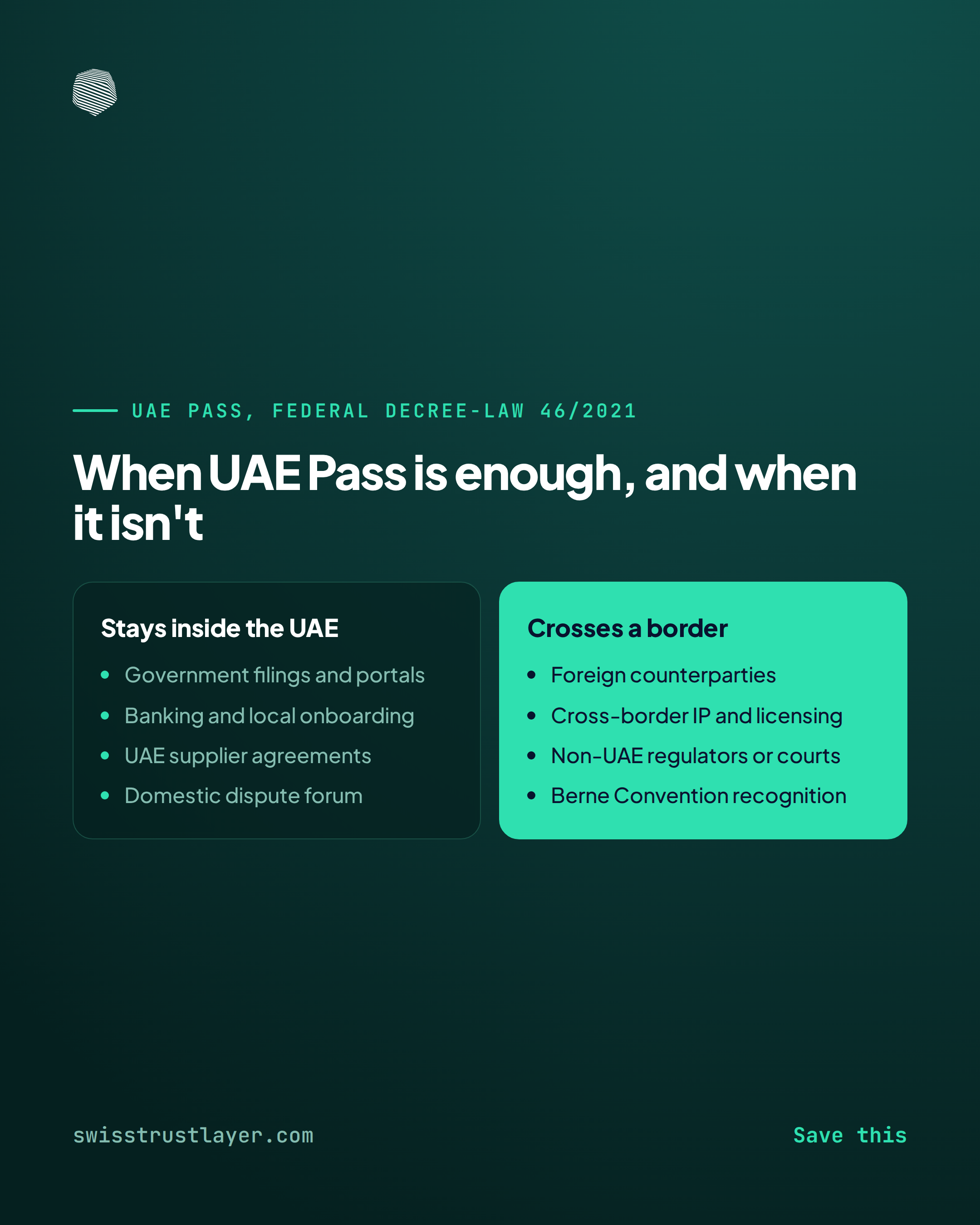
A Dubai-based operations manager needs a supplier agreement signed by end of week. The supplier is registered locally, the deal closes inside the UAE, and a government portal is asking for a signature right now. UAE Pass covers that case directly. A software company in Abu Dhabi signing a licensing deal with a partner in Frankfurt, or a Dubai design studio sending a copyright assignment to a client in London, is a different question, and UAE Pass alone does not answer it. This guide covers what UAE Pass actually does, what its signature carries legally, and where a business needs something more.
What UAE Pass is
UAE Pass is the United Arab Emirates' national digital identity and signing platform, launched in 2018 by Digital Dubai, the Telecommunications and Digital Government Regulatory Authority (TDRA), and the Department of Government Enablement. Registration runs through the mobile app: an Emirates ID number, a facial verification scan, and a mobile OTP confirmation. Once set up, UAE Pass gives a resident or citizen a single login across government services and a growing list of banks, telecoms, and private platforms, plus a document vault and a built-in e-signature function.
The legal basis
UAE Pass signatures sit inside a specific piece of federal legislation: Federal Decree-Law No. 46 of 2021 on Electronic Transactions and Trust Services. The law sets the conditions under which an electronic signature carries the same legal weight as a handwritten one, and it creates a licensing framework for trust service providers who create, validate, and preserve e-signatures, e-seals, and digital certificates. TDRA regulates that licensing and the technical standards behind it, while the Federal Authority for Identity, Citizenship, Customs and Port Security handles trust services on the government side. The current regulatory framework is set out on the official UAE government platform. UAE Pass itself is not formally listed as a licensed trust service provider under that framework, but it is government-operated and accepted across thousands of federal, emirate-level, and private-sector services as a matter of practice, which is a different and narrower basis than a licensed trust service provider's signature carries.
When UAE Pass is the right tool
For anything that stays inside the UAE's own legal and administrative system, UAE Pass is usually the fastest and most appropriate route: government filings, banking onboarding, real-estate transactions through the Dubai Land Department, employment contracts, local supplier and vendor agreements, and any portal that already accepts it as a login and signing method. It costs nothing to residents and citizens, it is tied to a verified national identity, and it is recognised by the counterparties that matter for those transactions because they built their systems around it.
Where it stops being enough
UAE Pass proves identity and signing intent inside the UAE's own framework. It does not carry an automatic route to recognition in a foreign court, under a foreign regulator, or inside a jurisdiction that has never agreed to treat a UAE government identity system as trustworthy for its own purposes. A licensing deal with a German distributor, an IP assignment to a US publisher, a construction contract that might end up litigated in a DIFC or ADGM forum against a non-UAE party, or a copyright dispute in a Berne Convention member state outside the Gulf: none of these have a guaranteed path back to a UAE Pass signature the way a domestic UAE filing does. The gap is not that UAE Pass is weak. A national identity system is built to be trusted inside its own borders first, and cross-border recognition is a separate legal question that has to be solved separately.
A simple guide to which route to use
- Identify where the document lives. Check whether the document, both parties, and the likely dispute forum sit entirely inside UAE jurisdiction.
- Check if it needs to travel. If a party, regulator, or court outside the UAE has to accept the signature or the proof behind it, treat this as a cross-border case from the start.
- Match the document type. For creative or IP work, a design, a manuscript, a filing, proof of authorship and timestamp matters as much as signature identity, and that is a slightly different problem again.
- Plan for independent verification. Confirm that someone who was not part of the original signing can still check the record without needing a UAE Pass login themselves.
- Sign accordingly. Use UAE Pass directly for UAE-only administrative and government matters. Add a layer built for recognition outside the UAE when the document needs to travel further.
This is where Swiss Trust Layer's UAE Pass integration fits as a complement, not a replacement. A UAE-domiciled user authenticates with their UAE Pass identity, and the resulting seal is anchored to a Swisscom Trust Services qualified chain under Swiss ZertES and EU eIDAS, giving the document standing in both the UAE and the 181 Berne Convention member countries that recognise Swiss qualified trust services. It is not a substitute for UAE Pass on a government portal that requires UAE Pass specifically, and it does not claim to be one. It is what a business reaches for once a document needs to travel further than the UAE Pass identity system was built to go.
The practical takeaway
Keep UAE Pass for what it is built for: fast, verified, government-backed signing inside the UAE. For anything crossing a border, involving a non-UAE counterparty, or likely to be tested outside a UAE court, add a signature layer built for that wider reach before the document goes out, not after a dispute starts.